 |
|
||||||||
 |
||||||||



A Look Into the Markets |

Mortgage rates improved this week after climbing to some of the worst levels seen in over a month. Let's discuss what happened and look at the week ahead. “And I got a peaceful, easy feelin' And I know you won't let me down, Cause I'm already standin' On the ground” —Peaceful Easy Feeling by Eagles. Optimism in the Middle East Markets responded positively to calmer conditions in the Middle East as the cease-fire continues to hold and cautious optimism grows that a broader path toward stability may be developing. While tensions remain elevated, investors appeared encouraged by the lack of further escalation and reduced fears surrounding global energy supply disruptions. This matters because oil and mortgage rates ebb and flow together. As tensions eased, oil and Treasury yields both edged lower, helping mortgage pricing improve. If conditions improve and oil moves lower still, rates will follow suit. The opposite is true. New Home Sales Jump New Home Sales surprised sharply to the upside, jumping 7.45 to an annual pace of 682,000 units. The stronger-than-expected reading suggests housing demand remains resilient despite the recent spike in mortgage rates and ongoing geopolitical uncertainty surrounding Iran. It's reasonable to see even better New Home Sales reports in the future, should oil and global uncertainty decline further. Labor Market Remains Resilient Labor market data also remained solid. ADP Private Payrolls came in stronger than expected with 152,000 jobs added, signaling hiring activity continues at an OK pace. Continuing Jobless Claims, which track individuals receiving ongoing unemployment benefits, fell to the lowest levels in nearly two years. Initial Jobless Claims also remain near the 200,000 level, which is historically low and consistent with a healthy labor market. Overall, employers still appear reluctant to reduce headcount. 4.35% The 10-year Treasury briefly moved above 4.35% and accelerated toward 4.45% before retreating beneath this important pivot point. Historically, when the 10-year breaks above 4.35%, there tends to be a gravitational pull toward 4.50% - much like we witnessed in March. However, if yields remain beneath 4.35%, the probability increases for downward momentum toward the 4.20% area. 30-Year Mortgage Rates and 10-Year Note 30-Year Fixed Mortgage Rate (Freddie Mac daily average, May 7, 2026)
10-Year Treasury Note Yield (daily close, May 7, 2026)
Looking Ahead Markets now turn their attention toward upcoming Housing data, CPI, PPI, and Retail Sales reports. Inflation readings remain especially important because they will heavily influence expectations amongst the Federal Reserve under a new Fed Chair Kevin Warsh. The bond market will need to absorb a fresh supply of Treasuries including 3- and 10-year notes, and 30-year bonds. Bonds hate more bonds – so the buying appetite, or lack thereof, could be a market mover next week. |
Mortgage Market Guide Candlestick Chart |
|
Each candle represents one day of trading. As mortgage bonds prices move higher, rates move lower. You can see on the right side of the chart, how mortgage bond prices bounced higher after touching nearly one month lows. Chart: Fannie Mae 30-Year 5.5% Coupon (Friday, May 8, 2026)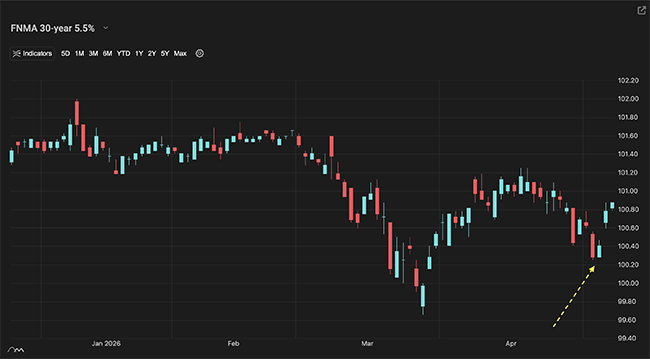 Economic Calendar for the Week of May 11 - 15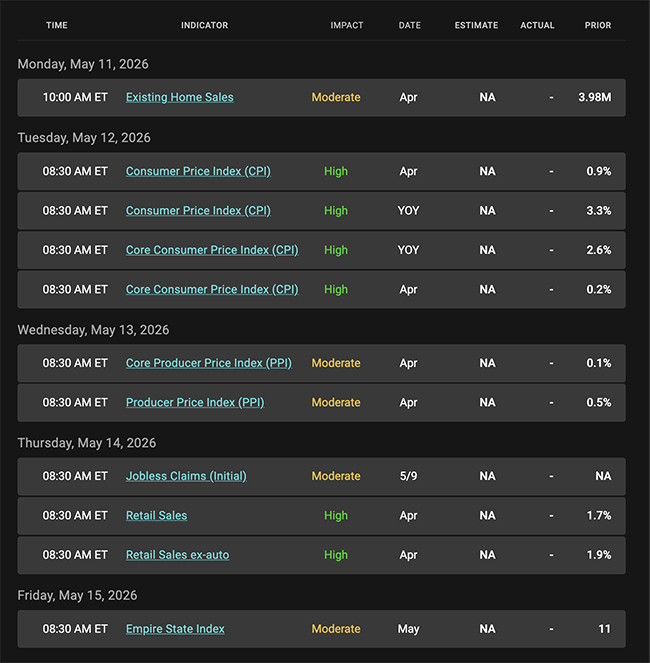 |
