 |
|
||||||||
   |
||||||||



A Look Into the Markets |

Interest rates climbed back toward their highest levels of the year following this week's Federal Reserve meeting. While the Fed did exactly what markets expected by leaving short-term rates unchanged, it was what Chairman Kevin Warsh didn't say that captured Wall Street's attention. Let's review what happened and look ahead to another important week of economic data. “And the vision that was planted in my brain, Still remains, Within the sound of silence”. Sound of Silence by Simon and Garfunkel. The Fed Quietly Holds The Federal Reserve left the Fed Funds Rate unchanged, as expected. While the decision itself wasn't surprising, the vote certainly was. Three FOMC members dissented in favor of raising rates, a sign that concerns over inflation remain alive inside the Committee. Markets had quietly feared even more policymakers might break ranks, so limiting the dissent to three helped avoid an even more hawkish surprise. Chairman Kevin Warsh then held a 45-minute press conference that revealed very little about the future path of interest rates. That appears to be by design. Since taking over as Fed Chair, Warsh has made it clear he wants markets focused on incoming economic data and not on trying to predict the Fed's next move. He repeatedly declined to provide forward guidance while reaffirming the Fed's unwavering commitment to returning inflation to its 2% target. Perhaps most notable for mortgage markets, Warsh appeared comfortable with the recent rise in long-term Treasury yields. He acknowledged that market rates have moved higher and suggested that's exactly how financial markets should function, responding to economic fundamentals instead of Fed hints. In other words, higher long-term rates alone aren't likely to push the Fed into changing policy. Consumer Inflation Hits the Mark There was some encouraging inflation news this week. Core Personal Consumption Expenditures (Core PCE), the Federal Reserve's preferred measure of inflation, rose just 0.1% during the month, coming in below expectations. Since Core PCE excludes the more volatile food and energy categories, it provides the Fed with a clearer picture of underlying inflation trends. While one report won't determine monetary policy, softer inflation readings like this move the data in the right direction and support the Fed's longer-term objective of returning inflation toward its 2% target. A Trend That May No Longer Be Our Friend For several weeks we've been highlighting a fascinating long-term Treasury market trend. Over the past 19 years, every time the 10-Year Treasury yield has touched 4.60%, it has traded back below that level within 90 days. That streak is now under serious pressure. The 10-Year Treasury is currently yielding approximately 4.68%, and unless yields fall back below 4.60% by mid-August, that remarkable 19-year pattern will officially come to an end. Markets don't follow historical trends forever, but when long-standing patterns begin to break, it's worth paying attention. If this one fails, it could signal a shift toward a higher long-term interest rate environment, something mortgage and housing professionals will want to watch closely. 30-Year Mortgage Rates and 10-Year Note 30-Year Fixed Mortgage Rate (Freddie Mac daily average, July 30, 2026)
10-Year Treasury Note Yield (daily close, July 30, 2026)
Looking Ahead The labor market continues to show remarkable resilience and jobs buy homes. That makes next week's employment reports especially important for both the Fed and mortgage markets. Here's what's on deck: ADP Employment Report: An early look at private-sector hiring. July Jobs Report: The week's headline event and one of the market's most closely watched reports. JOLTS Job Openings: The amount of jobs available and another measure of labor demand that the Fed continues to monitor closely. ISM Manufacturing Index: A key gauge of business activity and economic momentum. Weekly Jobless Claims & Productivity: Additional insight into the health and efficiency of the labor market. Federal Reserve Speakers: Markets will continue listening for any clues, even if Chairman Warsh remains committed to saying very little. With Treasury yields pressing against important technical levels and several high-impact economic reports ahead, next week could play an important role in determining whether rates remain near their highs or finally find some relief. |
Mortgage Market Guide Candlestick Chart |
|
Each candle represents one day of trading. As mortgage bonds prices move higher, rates move lower. You can see on the right side of the chart, how mortgage bond prices fell to the worst levels of the year. Chart: Fannie Mae 30-Year 5.5% Coupon (Friday, July 31, 2026)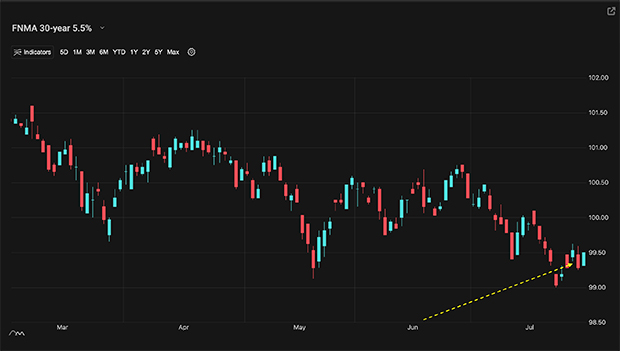 Economic Calendar for the Week of August 3 - 7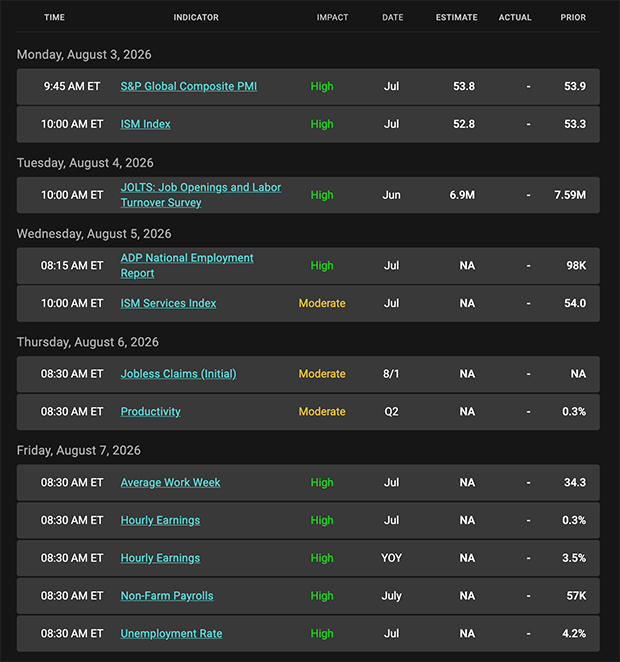 |